-
Title
-
Untitled
-
Alternative Title
-
Self-Portrait
-
Description
-
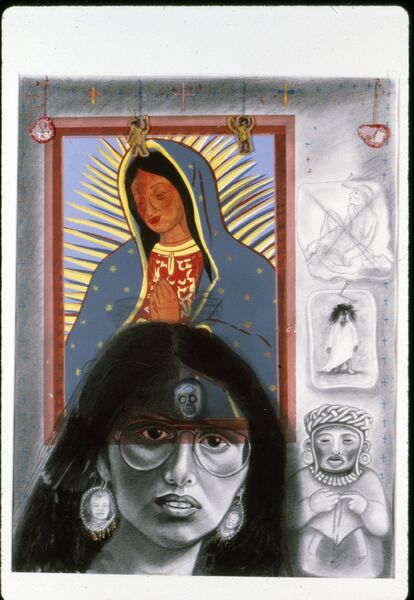
This self-portrait is composed of multiple media including three-dimensional milagros created of paper and thread. The image of the Guadalupe is appropriated from a serigraph or silkscreen print created at Diseño Studios in Austin, Texas. The self-portrait that covers the bottom portion of Guadalupe is a charcoal drawing. Three images appear on the right side: the top image is a portrait of Popocatépetl and Iztaccíhuatl with an "x" mark of refusal, the middle figure is a dream-image, and the bottom image is inspired by a Mesoamerican goddess. A work of mixed media with pencil, charcoal, ink, embroidery thread, ribbon, tulle, and paper. Dimensions: 20" x 28"
-
Annotation
-
This work presents a layered and symbolic composition that merges personal identity with cultural and religious iconography. It is a work of mixed media with pencil, charcoal, ink, embroidery, thread, ribbon, tulle, and paper. At the center foreground is a portrait of a woman, the artist, rendered with a calm yet serious expression. Her direct gaze engages the viewer, suggesting self-awareness and strength. The use of grayscale for her figure contrasts sharply with the vibrant, warm tones behind her, immediately establishing a tension between individuality and inherited tradition. Dominating the background is the iconic figure of Our Lady of Guadalupe, framed in radiant gold and deep blue. This figure is deeply significant in Mexican and Chicana/o culture, symbolizing faith, protection, and cultural identity. By placing the Guadalupe directly behind the woman’s head, the artist visually aligns the two figures, implying a spiritual or cultural inheritance. It suggests that the woman’s identity is shaped, protected, or even constrained by this powerful symbol. The artist herself wears glasses, grounding her in a modern, intellectual context. This detail introduces a contemporary perspective, contrasting with the traditional, colonial, religious imagery behind her. On her forehead, a small skull motif appears, subtly referencing mortality, memory or, possibly, Indigenous symbolism connected to life and death. This element complicates the image further, blending Catholic and pre-Columbian visual languages.
Three additional images appear on the right side: the top image is a portrait of Popocatépetl and Iztaccíhuatl with an "x" mark of refusal; it resists the dominance of colonial narratives. The middle figure is a dream-image, and the bottom image is inspired by a Mesoamerican goddess (most likely referencing Coatlicue or Tonantzin). These ghostly outlines evoke memory, history, or cultural fragments—suggesting that identity is not singular but constructed through multiple influences over time. The faded quality of these images contrasts with the boldness of Guadalupe and the clarity of the artist’s face, reinforcing the idea of layered histories.
The overall composition can be interpreted as an exploration of Chicana identity, where personal selfhood intersects with cultural expectation and religious symbolism. The woman is neither fully separate from nor completely absorbed by the image behind her. Instead, she exists in dialogue with it—negotiating what it means to carry such a powerful icon within her sense of self. Ultimately, the image reflects themes of hybridity, spirituality, and self-representation. It invites viewers to consider how cultural symbols shape identity while also allowing space for reinterpretation and individuality. (Author: Alba Maldonado)
-
Identifier
-
SB_Untitled_Self_Portrait_1984
-
Access Rights
-
© 1983, Santa C. Barraza. This image may not be reproduced for commercial purposes without the written consent of the artist. The image may be used for educational personal individual uses and with credit to the artist. Please contact the artist for commercial purposes, reproduction and/or publication: santa.b@santabarraza.com