-
Title
-
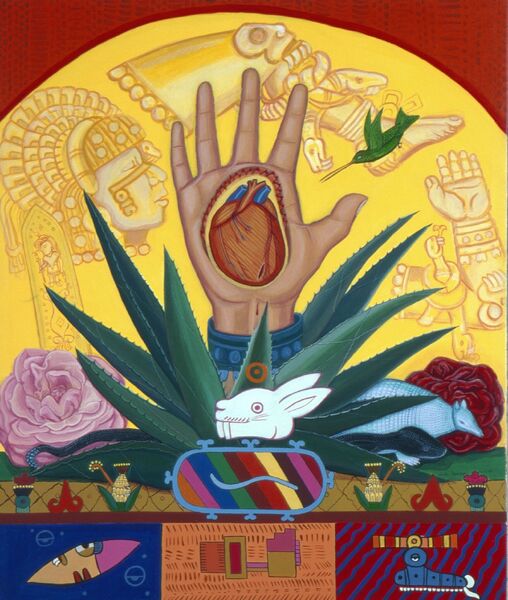
La Mano Poderosa de Coyolxauhqui
-
Alternative Title
-
Almighty Hand of Coyolxauhqui
-
Description
-
This painting was created during an artist residency of the Nepantla Project organized by Gloria E. Anzaldúa (1942-2004) in Saratoga, California. The central image is the Almighty Hand reimagined as the hand of Coyolxauhqui that emerges from a maguey and is surrounded by symbols. It is influenced by Anzaldúa's philosophy about Coyolxauhqui and the coming era of women's empowerment. Acrylic on canvas. Dimensions: 39" x 48"
-
Annotation
-
This acrylic painting references female empowerment as it is inspired by the Aztec Coyolxauhqui Stone and portrays the golden moon while Coyolxauhqui’s hand (representing the almighty hand) emerges from a maguey plant. The title and the hand are a reference to the devotional icon that dates to the Spanish colonial period. On either side of the central image are two roses. Below the maguey is a rabbit head, or Tochtli, which is flanked by additional Aztec iconography. The painting combines visual elements from two other motifs common in Barraza’s work, the codices and retablos.
Aside from female empowerment, this image may also represent family or familial support since Coatlicue (Serpent Skirt), Coyolxauhqui (She who Wears Bells on her Cheeks), and Huitzilopochtli (Hummingbird Left) are referenced in the painting. These familial ties are indicated by symbols such as the blue serpent (Coatlicue), beneath the maguey, and the green hummingbird (Huitzilopochtli), emerging between the thumb and the index finger of the central hand. There are also supporting plants and animals like the maguey and the armadillo (ayotochtli), both of which have similar meanings and represent fertility, abundance, and nourishment. Additionally, the maguey represents the goddess Mayahuel who also symbolizes transformation, abundance, and nourishment. An emphasis on transformation is reflected by Coyolxauhqui who emerges as the almighty hand from the maguey, which suggests Gloria Anzaldúa’s “Coyolxauhqui Imperative,” a healing from colonialism and patriarchy. Additional Aztec iconography appears near the maguey plant: the xochitl (flower), the acatl (reed), the tecpatl (flint or knife), calli (house), and possibly cipactli (alligator). (Author: Klarissa Garcia)
-
Identifier
-
SB_La_Mano_Poderosa_Coyo_1995.tif
-
Access Rights
-
© 1995, Santa C. Barraza. This image may not be reproduced for commercial purposes without the written consent of the artist. The image may be used for educational personal individual uses and with credit to the artist. Please contact the artist for commercial purposes, reproduction and/or publication: santa.b@santabarraza.com