-
Title
-
Codex de La Llorona de la Diosa de Maize
-
Description
-
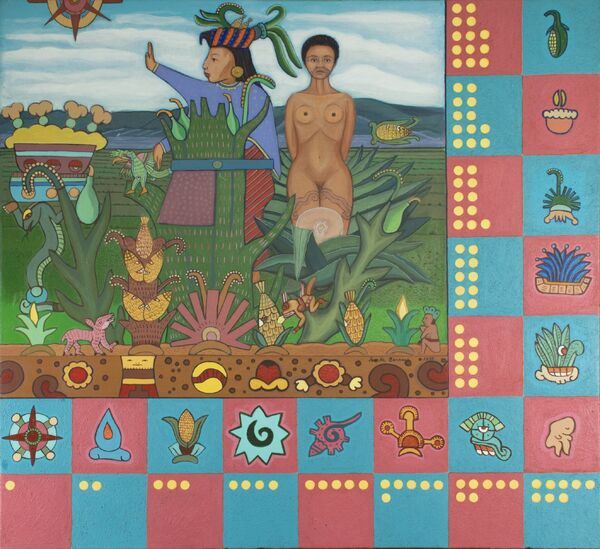
From the Codex Series, the artist visualizes a story that she learned from her mother. La Llorona emerges from the maguey which has a fetus. The diosa stands behind a corn plant, appropriated from a codex. Among the icons associated with La Llorona and the Corn Goddess are corn, cacao, water, a fetus, plants, a fertility symbol, and the sundial. Marble dust sourced from Mexico is used to create texture. Acrylic on canvas. Dimensions: 39 ¾" x 43 ½"
-
Annotation
-
The artist reimagines La Llorona (here, shown nude) by pairing her with La Diosa de Maize, transforming the weeping figure into a symbol of rebirth and cyclical renewal while challenging the narrative that cast her as a condemned woman. Drawing on pre-Colombian and colonial traditions, Barraza reframes La Llorona’s story to position death not as a moral failure, but as an essential and generative part of the life cycle. This shift is conveyed through dense iconographic imagery; corn, central to Mesoamerican cosmology, signifies sustenance, lineage, and generative power, while the sun and water invoke divine forces that sustain life and regeneration. The serpent further reinforces transformation and continuity, linking earthly and spiritual realms. Emerging through the maguey plant, La Llorona becomes part of an ongoing cycle of life, death, and rebirth, prompting viewers to reconsider how women’s actions and identities have been historically judged.
Through these layered symbols, Barraza constructs a narrative that reclaims and empowers feminine figures within Mexican and indigenous practices. At the composition’s center lies maize, a sacred symbol rooted in Mesoamerican belief. As recounted in the Popol Vuh, where humans are created from maize, it represents a vital life force connecting humanity to the divine. Here, maize anchors La Llorona’s rebirth, embodying continuity, fertility, and spiritual interdependence. The serpent, on the left, operates as a multilayered emblem associated with Quetzalcoatl, transformation, and passage between worlds. Its act of offering essence to the sun underscores the reciprocity of life, death, and renewal. Its ties to the underworld and its shedding of skin mirror regenerative cycles, while its connection to La Diosa de Maíze aligns with expansive cosmologies in which the sun functions as both life-giver and protector. The sun, as a shield-like form, transcends its celestial role to signify protection and generative energy. In Mesoamerican traditions, it required nourishment through sacrifice to sustain cosmic order. Here, it echoes the sustaining qualities of La Diosa de Maíze, reinforcing cycles of growth, decay, and renewal governed by sacred forces. The humanized maize figure evokes origin narratives in which humans are created from corn, reinforcing La Llorona’s rebirth through divine assistance. Water, depicted as a river, symbolizes fertility, purification, and the passage between life, death, and the underworld.
Finally, Mayahuel, goddess of rebirth is represented in the maguey plant. As La Llorona emerges from the maguey this further links the symbolism of rebirth. Additional motifs—such as a fetus, stages of corn growth, animals, and insects—depict the unity of all life within a continuous cycle, ultimately transforming La Llorona as a figure of sacred regeneration rather than tragedy. (Author: Gabriela Marie Mendoza)
-
Identifier
-
SB_Codex_Llorona_1995_103
-
Access Rights
-
© 1995, Santa C. Barraza. This image may not be reproduced for commercial purposes without the written consent of the artist. The image may be used for educational personal individual uses and with credit to the artist. Please contact the artist for commercial purposes, reproduction and/or publication: santa.b@santabarraza.com