-
Title
-
Coatlicue con Milagros
-
Alternative Title
-
Coatlicue with Milagros
-
Description
-
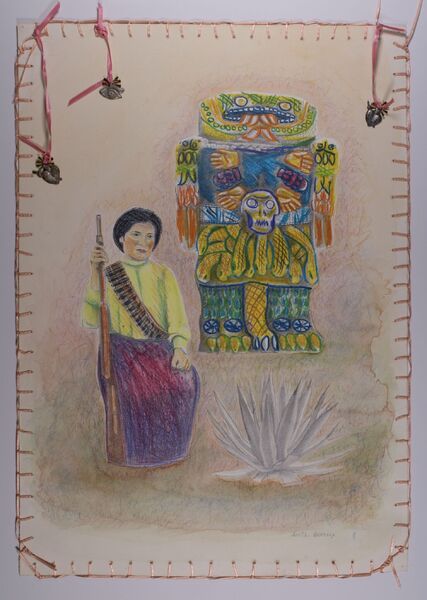
The work depicts Coatlicue and La Adelita, appropriated from a Agustín Víctor Casasola (1874-1938) photograph of the Mexican Revolution. Mixed media with manipulated collagraph. Dimensions: 18 ½” x 13"
-
Annotation
-
This mixed-media piece combines Indigenous symbolism, Mexican revolutionary imagery, and Catholic devotional traditions. Barraza is known for incorporating elements of Chicana identity, spirituality, and cultural history into her work. In this piece, she visually connects ancient Aztec mythology with the history of Mexican resistance and contemporary Chicana struggle.
At the center of the composition is the figure of Coatlicue, an important female Aztec deity associated with earth, fertility, and life cycles. Coatlicue is traditionally depicted wearing a skirt of serpents and possessing powerful, sometimes fearsome features that symbolize both creation and destruction. In Barraza’s interpretation, the figure appears colorful and stylized, emphasizing patterns and symmetry that recall Mesoamerican sculpture and codices. The presence of Coatlicue symbolizes Indigenous roots and spiritual strength, highlighting the importance of pre-colonial culture within Chicana identity.
Next to the deity stands a woman holding a rifle and wearing a bandolier of ammunition. This figure represents La Adelita, a symbol of the “soldaderas,” women who participated in the Mexican Revolution as fighters, supporters, and caretakers. Barraza based this figure on a historical photograph by Agustín Víctor Casasola, who documented many scenes from the Mexican Revolution. By referencing this iconic image, Barraza connects the revolutionary past to broader themes of female strength and resistance. The Adelita figure represents courage, political participation, and the role of women in shaping Mexican history.
At the bottom of the composition is a maguey (agave) plant, an important symbol in Mexican culture. The maguey plant has long been used for food, fiber, and traditional beverages such as pulque. In many Indigenous traditions, it also represents the relationship between humans and the land. Its inclusion reinforces themes of cultural heritage and the deep connection between identity and the natural environment.
The border of the artwork is stitched and decorated with small hanging objects known as milagros, which are small metal charms traditionally used in Mexican devotional practices. Milagros are often attached to religious shrines or offerings as symbols of prayers, healing, or gratitude. By incorporating milagros and a textile-like border, Barraza transforms the artwork into something resembling a sacred or commemorative object, similar to a shrine or retablo.
Overall, the piece brings together multiple layers of iconography: Indigenous mythology, revolutionary history, and religious symbolism. Through these elements, Barraza creates a visual narrative that celebrates cultural memory, female empowerment, and Chicana resilience. The work demonstrates how art can function as a space where history, spirituality, and identity intersect. (Author: Priscilla Lacayo Huesca)
-
Identifier
-
SB_Coatlicue_Milagros_1986_98
-
Access Rights
-
© 1986, Santa C. Barraza. This image may not be reproduced for commercial purposes without the written consent of the artist. The image may be used for educational personal individual uses and with credit to the artist. Please contact the artist for commercial purposes, reproduction and/or publication: santa.b@santabarraza.com